
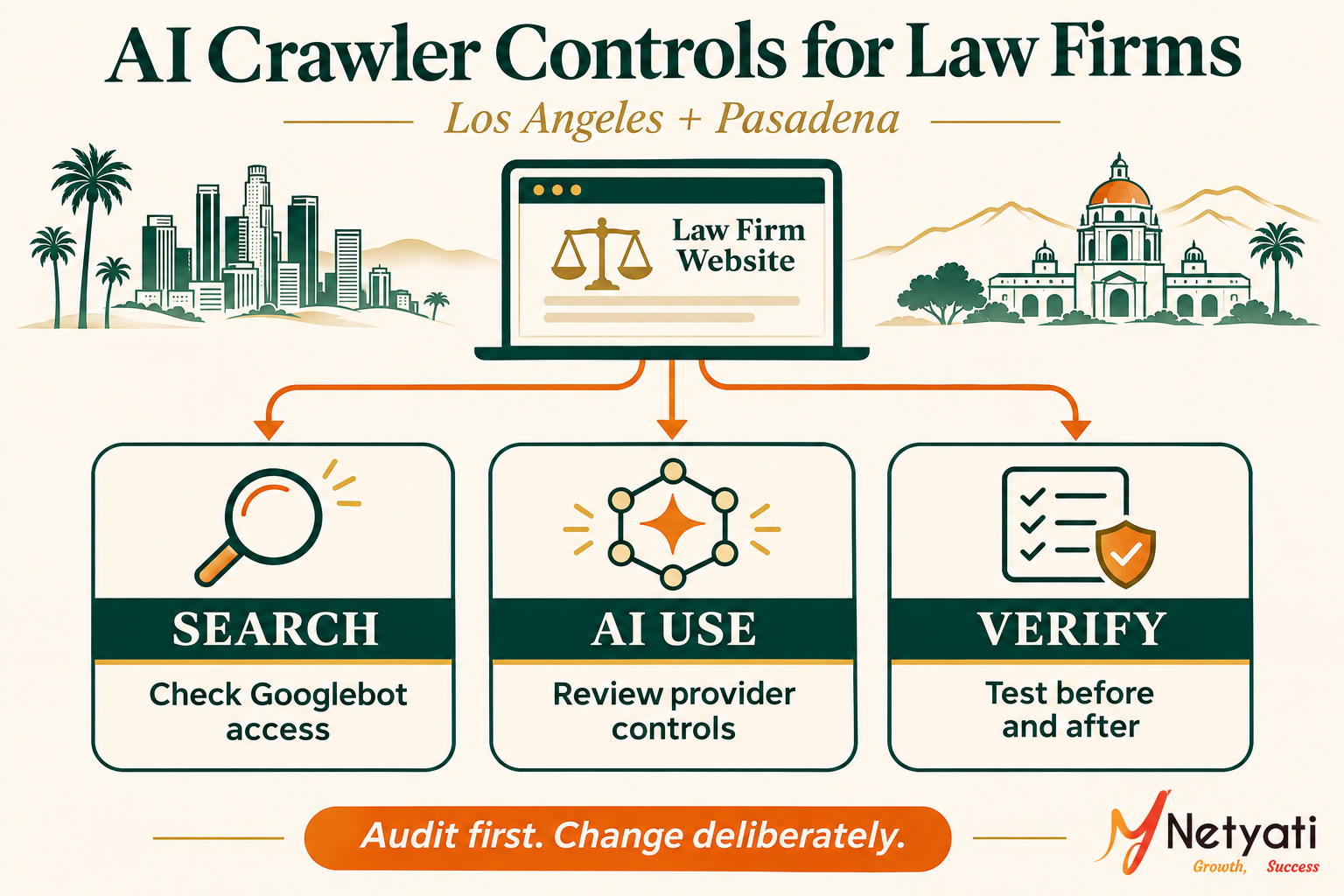
Law firm AI crawler controls deserve a careful review, especially when a website depends on local search enquiries. A Los Angeles or Pasadena firm may want to make a deliberate choice about AI training while keeping its public service pages discoverable. Those are different decisions, and a broad blocking rule can confuse the two.
On October 30, 2026, Google announced plans to support a shared AI training control in robots.txt. Google says it aims to support the mechanism in 2027. This is a development to prepare for, not a reason to assume a new standard is already active everywhere.
For firms building a long-term search presence, crawler settings belong inside a wider plan for law firm SEO in Los Angeles and Pasadena. Start with the pages that explain your services and the people behind them, then decide how different systems should access or use that content.
Separate Google Search access from AI-use preferences
Google’s crawler documentation distinguishes Googlebot from Google-Extended. Googlebot rules affect Google Search crawling. Google-Extended governs certain Gemini training and grounding uses; Google says it does not determine inclusion in Google Search or act as a Search ranking signal.
That distinction matters when someone proposes “blocking AI.” Ask which provider, which control and which product they mean. A setting for one provider is not a universal switch for every AI tool. Also ask whether the change affects training, retrieval, search crawling or more than one use. Record the answer before implementation.
Build a short inventory of the pages that matter
Choose a small sample: the homepage, a core practice-area page, a genuinely useful local page, an attorney biography and a supporting article. Record the public URL, intended audience and next step for each. This gives the developer a concrete test set rather than an instruction to “check the website.”
For an LA practice with a Pasadena office, verify that the local page reflects the real office and services. If the firm only serves Pasadena remotely, say so accurately. Crawler controls cannot repair a misleading location claim. Our guide to Pasadena law firm SEO explains how to build local relevance without thin city pages.
Use a before-and-after change checklist
Assign one person to approve the business preference and another to implement and verify the technical change. They may work at the same agency, but the responsibilities should be explicit. Keep a dated copy of the current settings and a plain-language explanation of what will change.
Before the change
Record the current crawler rules and any related hosting or security settings. Check the sample URLs in Search Console and note their current status. Confirm that the team can restore the previous configuration if testing reveals an unintended restriction. Do not combine an AI-control change with a redesign or a large URL migration unless the project requires it.
After the change
Repeat the same checks on the same URLs. Ask the developer to confirm which user-agent rules apply and whether a firewall or hosting feature adds another restriction. Keep the implementation date in your reporting notes. A sudden change in visibility deserves investigation, but timing alone does not prove that the crawler setting caused it.
Keep public content useful and confidential material separate
Review what the firm actually publishes. A useful service page explains who the firm helps, what the service covers and how to request a conversation. A helpful article answers a real question with appropriate professional review. Neither needs confidential client details to be valuable.
Use the same editorial review when refreshing law firm practice-area pages. Identify the responsible attorney or reviewer where appropriate, check factual claims and remove outdated information. Treat access to private client systems as a separate security matter, rather than relying on a public crawler preference.
Questions to ask your SEO provider this month
Ask for three deliverables: a current settings inventory, a written recommendation tied to the firm’s preferences, and a verification record. The recommendation should distinguish controls supported today from proposals expected later. If a proposed change has no clear purpose or test plan, pause that change until the team can explain it.
Review the decision again when providers publish implementation updates. There is no need to rewrite settings every time an AI headline appears. A clear owner and a scheduled review are more useful than a growing collection of copied rules.
Make AI crawler controls part of a measured SEO plan
The practical goal is deliberate access, accurate content and a website that remains usable for prospective clients. Crawler settings alone do not create authority or guarantee rankings. Netyati can help connect this technical review with content and local search priorities; request a focused website review and include the pages that matter most to your firm.
Editorial note: reviewed November 4, 2026. The shared AI training control discussed above is a planned development; check the linked provider documentation before making implementation decisions.