
Tag: legal marketing

  • Law Firm SEO Content Strategy: Connect Practice Pages and Helpful Articles

    A law firm SEO content strategy works best when it supports the pages that describe the firm’s services. Publishing articles on unrelated legal topics may add URLs to the site, but it does not automatically make the firm’s most important practice pages more useful or easier to find.

    A focused law firm SEO content strategy starts with the prospective client’s questions and gives each question a clear home on the website.

    Choose a practice area to build around

    Begin with a practice area the firm genuinely handles and wants to grow. Review the current service page, related attorney biographies, existing articles, and the questions the intake team hears. This creates a starting inventory before anyone writes a new post.

    Group the questions by intent. Some belong on the core service page, such as what the firm handles and how to contact the team. Others may justify separate resources because they call for a detailed explanation, checklist, or comparison. The goal is to serve each intent clearly, not to create a separate URL for every keyword variation.

    Give every article a specific job

    Before drafting, write down the reader, the question being answered, and the page the article should support. If another page on the site already answers the same question, update or improve that page instead of creating a competing version.

    Strong supporting topics are narrow enough to answer well and closely related to the firm’s services. For an employment practice, that might mean explaining how a particular workplace issue is evaluated, what documents someone may want to organize before speaking with counsel, or what questions to ask during an initial consultation. The firm should decide which topics fit its expertise and review the legal substance before publication.

    Make expertise visible

    Readers should be able to tell who created or reviewed legal information and why that person is qualified to speak on the subject. Use accurate attorney biographies, clear author or reviewer details, and a practical review process. Keep dates and citations current when a post depends on changing law or procedure.

    AI tools can help organize ideas or edit a draft, but they do not replace attorney judgment, source checking, or approval. Avoid publishing claims about legal outcomes, deadlines, or rights without the firm’s review.

    Connect articles to service pages naturally

    Use internal links where they help the reader take the next step. A guide answering an informational question can link to the relevant practice-area page; that page can link back to useful resources and the attorney profiles behind the work. Use link text that describes the destination rather than repeating an exact keyword in every link.

    Keep location content equally deliberate. Our Los Angeles law firm SEO guide explains local search priorities, while our Pasadena law firm SEO guide shows how to create useful location content. A local article should add real market context. A city page should exist only when it provides distinct value to someone in that location, not because a publishing plan calls for another geographic phrase.

    Measure the cluster over time

    Use Search Console to review which queries bring people to each page, whether clicks and impressions are changing, and whether several URLs appear to compete for the same intent. Pair that with appropriate lead tracking so the firm can see whether search activity is producing relevant enquiries. Protect confidential client information in any measurement process.

    Review the cluster periodically. Merge overlapping pages when appropriate, improve resources that are useful but outdated, and add a new article only when a genuine content gap remains. A smaller set of accurate, connected pages is easier to maintain than a large archive of near-duplicates.

    That is the purpose of a content strategy for law firm SEO: make the firm’s expertise clear, help people find a useful answer, and connect that answer to the service the firm can provide. See Netyati’s Law Firm SEO services for more about building a connected legal search strategy.
  • Pasadena Law Firm SEO: Local Visibility Without Thin City Pages

    Pasadena Law Firm SEO: Local Visibility Without Thin City Pages

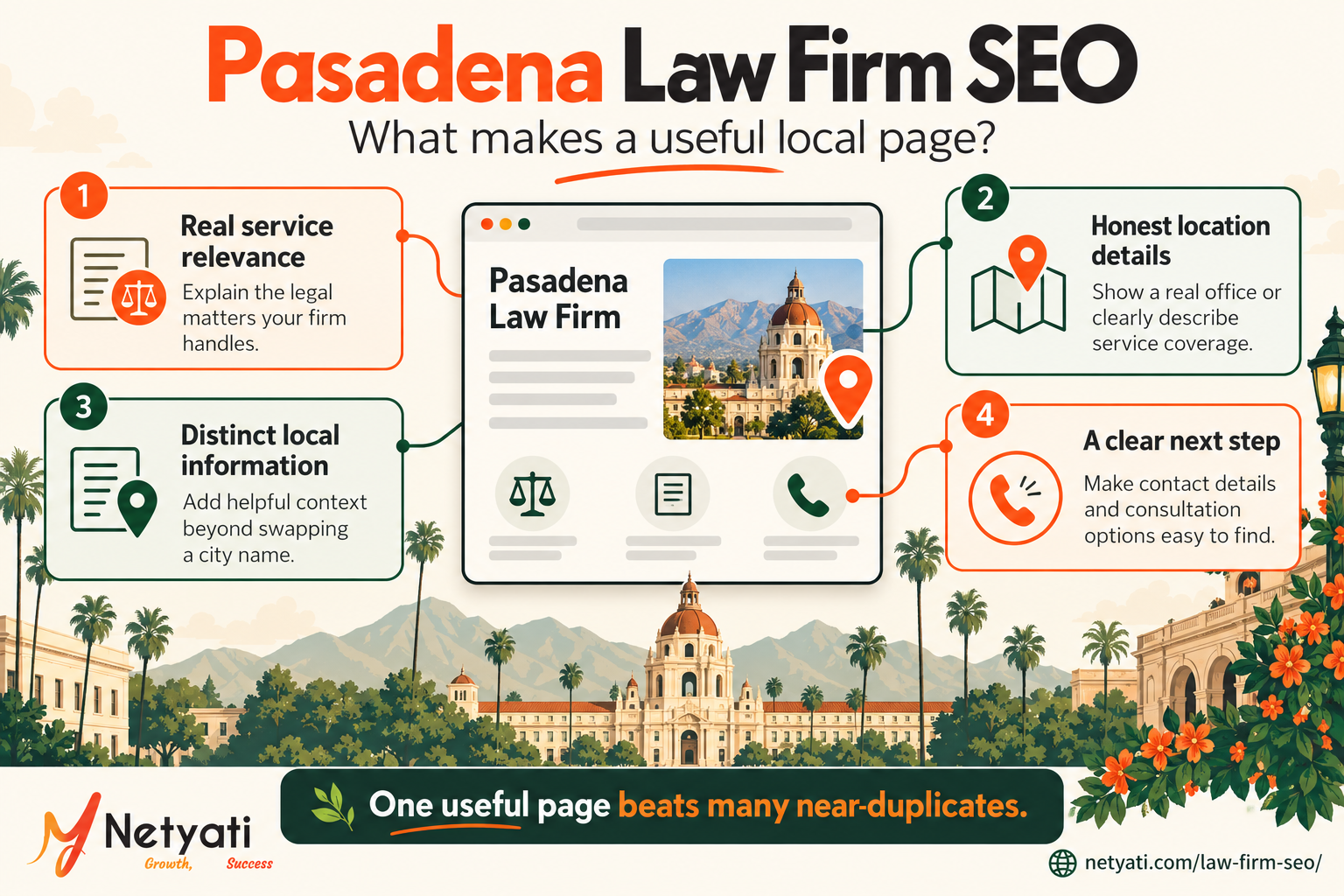
    Four elements of a useful Pasadena law firm page. Infographic by Netyati.

    Pasadena law firm SEO begins with clarity: what legal work does the firm handle, who can it serve, and what makes its connection to Pasadena real and useful to a prospective client? The answer should be visible across the website without creating a stack of pages that merely repeat the city name.

    Build around real services and real service areas

    Start with the practice areas the firm actually wants to grow. A strong service page explains the legal issue in accessible language, identifies the attorneys responsible for the work, answers common questions at an appropriate level, and gives visitors a clear next step. If a firm serves Pasadena as part of a wider Los Angeles County practice, describe that honestly and consistently.

    Do not imply that the firm has a Pasadena office unless that is true. Avoid adding a location page for every neighboring community when the firm cannot provide distinct, useful information for each one. Thin pages can confuse visitors and make it harder for search engines to identify the page that best represents the service.

    Give a Pasadena page a reason to exist

    A separate Pasadena page can be useful when it offers substantive local information: the services available to people in the area, the attorneys who handle those matters, how consultations work, and any genuine local experience the firm can substantiate. Keep the page connected to the relevant practice-area pages and attorney profiles.

    Before creating a new URL, ask: Would a person in Pasadena learn something useful here that they would not find on the main practice page? If the honest answer is no, strengthen the main page instead. Local relevance comes from accurate details and a coherent website, not a city name repeated in headings.

    Keep business listings accurate

    Review the firm’s Google Business Profile and other important listings for accuracy. Google asks businesses to represent themselves as they are in the real world and to keep address or service-area details precise. Check the current Google guidelines for representing a business before editing locations or creating additional profiles. A search marketing agency should never invent an office or create duplicate listings to target nearby cities.

    Reputation also needs a careful process. Invite genuine feedback in a consistent way, protect client confidentiality, and let the firm’s lawyers review any approach that touches professional obligations or client communications.

    Connect the local page to the rest of the site

    Make it easy to move between the Pasadena information, the main service page, attorney biographies, and genuinely helpful resources. Use descriptive links that explain where they lead. A visitor researching an employment issue should be able to reach the employment-law service page without navigating a maze of generic “read more” buttons.

    For the wider market, read our Los Angeles law firm SEO guide. Our law firm content strategy guide explains how supporting articles connect to service pages.

    Keep technical details tidy too: use one preferred URL for each page, make sure important pages are linked internally, and include the correct URLs in the site’s sitemap. Search engines need to be able to discover the pages, but indexing is never guaranteed.

    Measure local visibility by useful outcomes

    Review organic search queries and landing pages in Search Console, and look at Google Business Profile performance where the firm is eligible and has access. Compare Pasadena-related visibility with relevant calls, form enquiries, and consultation requests. A position can vary by searcher and context, so use trends rather than a single ranking check.

    For firms competing in Pasadena and nearby Los Angeles markets, a focused local SEO plan usually means improving the pages that already represent the firm’s work, adding a local page only when it has distinct value, and keeping all location information accurate.

    Learn more about Netyati Law Firm SEO and its approach to local search, practice-area content, and site structure.

  • Law Firm SEO in Los Angeles: A Practical Local Search Strategy

    Law Firm SEO in Los Angeles: A Practical Local Search Strategy

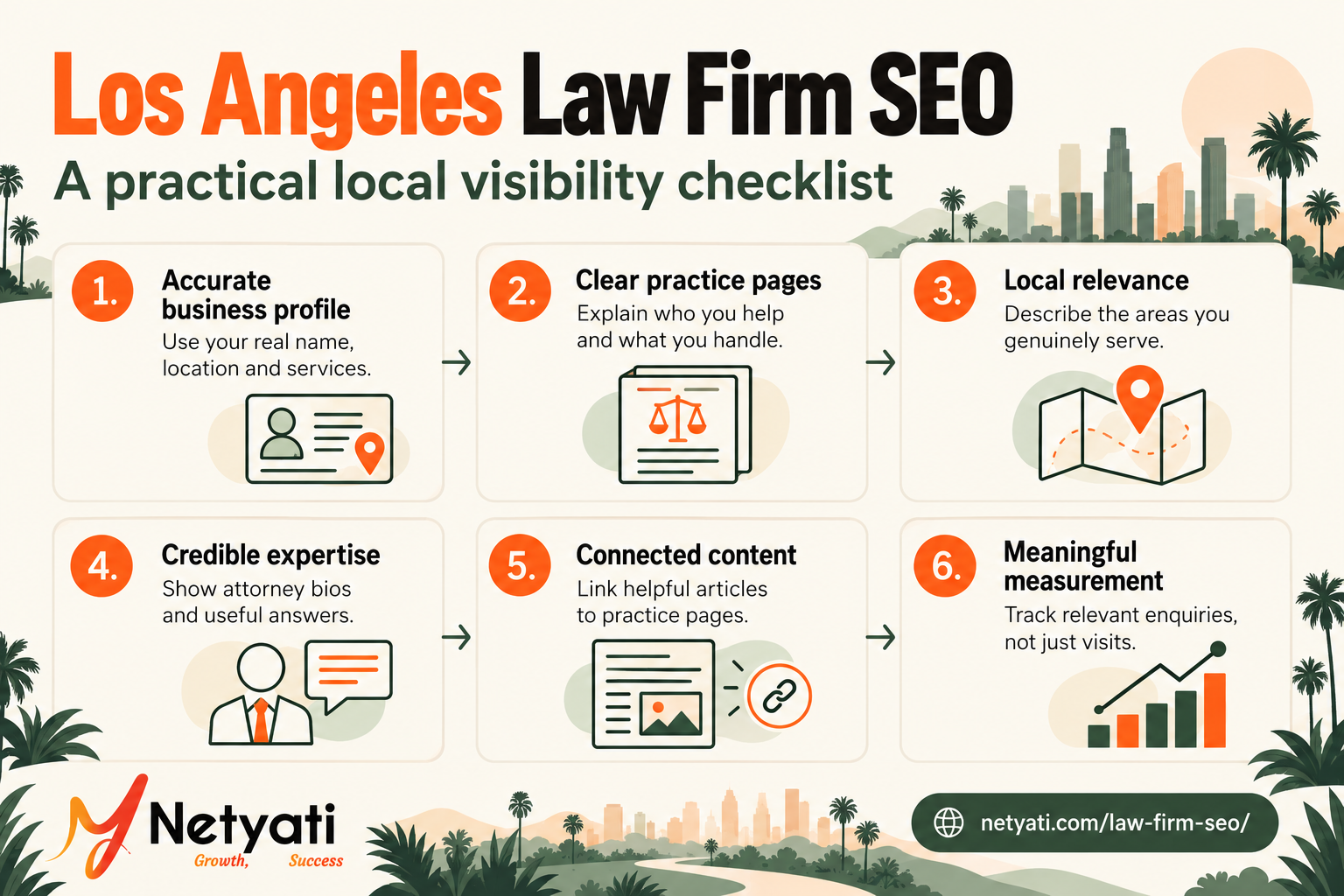
    Six practical priorities for Los Angeles law firm visibility. Infographic by Netyati.

    Los Angeles is a broad, competitive legal market. A firm may serve clients across the county while still needing to be visible for a specific practice area in a specific part of the region. Los Angeles law firm SEO starts by making those relationships clear to people and search engines.

    Start with the cases and clients the firm wants to reach

    Before adding pages or keywords, define the firm’s priorities. Which practice areas are a focus? Which clients can the firm serve well? What locations are genuinely part of its service area? These answers help separate useful search opportunities from phrases that look attractive in a spreadsheet but do not fit the firm.

    Map the main searches to the right page. A person looking for an employment attorney needs a clear service page. Someone researching a workplace issue may need an educational resource. A search that includes a city may need local context. One page rarely serves every intent equally well.

    Make practice-area pages useful, not just optimized

    A practice-area page should help a prospective client understand what the firm handles and what to do next. Explain the service in plain language, describe the types of questions the firm can address, introduce the attorneys responsible for the work, and make contact options easy to find. Any statements about experience, results, or legal rights should be reviewed by the firm before publication.

    Support that page with related resources only when they answer distinct questions. For example, an employment-law practice page might be supported by guides about retaliation, workplace discrimination, or wage-and-hour concerns. Each article should add depth and link naturally to the relevant service page. See our law firm SEO content strategy guide for a practical way to plan those connections.

    Build real Los Angeles relevance

    Location signals should reflect how the firm actually works. Keep office and contact information accurate. Describe the communities or courts the firm genuinely serves when that context is useful. If the firm has a real office in a particular city, explain what that means for clients there. Do not imply that the firm has an office, staff, or local presence where it does not.

    Our Pasadena law firm SEO guide explains what makes a nearby location page useful. A single, substantive regional page can be more useful than many near-identical pages that swap “Los Angeles” for another city. Create a separate location page only when the firm can provide meaningful, specific information for that market, such as relevant services, attorney availability, local experience, or practical client details.

    Connect local search with the website

    Organic search and map results are related parts of discovery, but they have different requirements. Make sure the firm’s public business information is consistent and review the current Google Business Profile rules before changing categories, addresses, or service areas. Encourage genuine client feedback through a consistent, ethical process and follow the firm’s applicable professional obligations.

    On the website, connect attorney biographies, practice pages, local information, and useful articles with clear internal links. This helps visitors move from a question to the attorney or service page that can help them. It also makes the site’s structure easier to understand.

    Measure enquiries, not only positions

    Track which pages attract relevant organic visits, what searches bring people to them, and whether visitors take useful next steps. Review calls and forms with appropriate privacy safeguards. Ranking reports can show visibility, but they do not explain on their own whether a campaign is reaching the right clients.

    For a Los Angeles law firm, a practical SEO program usually combines a small number of strong service pages, credible local context, attorney expertise, helpful supporting content, sound technical foundations, and regular measurement. The goal is to make the right page easier to find and more useful when a prospective client arrives.

    Explore Netyati’s Law Firm SEO approach for more on practice-area strategy, local search, legal content, and measurement.